Tarzan Crawling and Bottom Scooting

Exercise program for children who crawl on one knee and one foot (Tarzan crawling) or move forward by bottom scooting and are not yet able to walk without support. The program contains the same exercises as the program for Walking, plus important additions and variations focusing on correcting the movement patterns that lead to Tarzan crawling and bottom scooting.

  • Prioritized, simple exercises
  • Designed for busy families
  • Illustrated with pictures & videos
  • Instant & perpetual access
  • Secure payment with QuickPay

Available languages

299,00 DKK

(inclusive of all taxes, VAT and fees)

Klarna

Program description

Crawling on all fours is a key milestone because it strengthens both coordination and the bodyโ€™s strength and stability. However, some children find it difficult to crawl on all fours with a cross-over pattern and instead switch to Tarzan crawling (crawling on one knee and one foot) or bottom scotting. Fortunately, there is a lot we can do to help your child strengthen exactly those muscles that are not naturally trained when crawling on all fours has not been achieved.

The aim of this program is therefore to balance the strength differences between the two sides of the body and strengthen your childโ€™s body as well as possible before they start walking. We should not rush into independent walking by only training the muscles needed to “just” walk straight ahead. If we do, we risk depriving the body of important, symmetrical strengthening of the core muscles, which is crucial for good postural stability later in life. The exercises in this program are therefore not a shortcut to walking, but a way to help your child strengthen exactly the muscles needed to use their body in an upright position in a varied and stable way.

The exercises in this program focus on strengthening the relevant muscles around the tummy/back (trunk), hips, knees, and ankles, as well as promoting the sense of balance. In addition, the program includes concrete tips to help your child find the courage to let go and walk freely through the room. The exercises can be used both as general play inspiration and when more targeted motor support is needed.

However, the goal of the exercises is not necessarily for your child to learn to crawl on all fours, as this is often difficult once Tarzan crawling or bottom scooting has become a habit. The real long-term goal is instead a strong, stable gait in a symmetrically strong childโ€™s body.

Note: If your child is not yet crawling on all fours, please choose instead this program: Crawling on All Fours.

What is Tarzan Crawling?

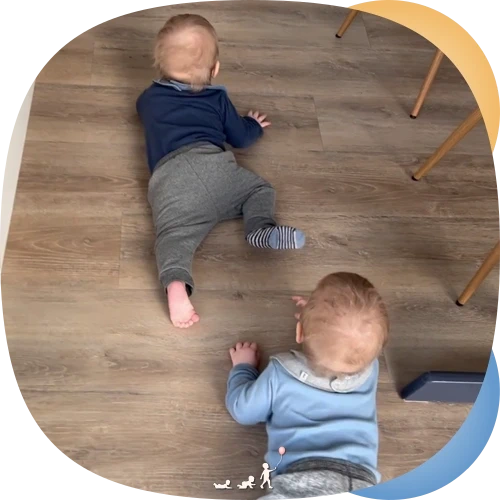
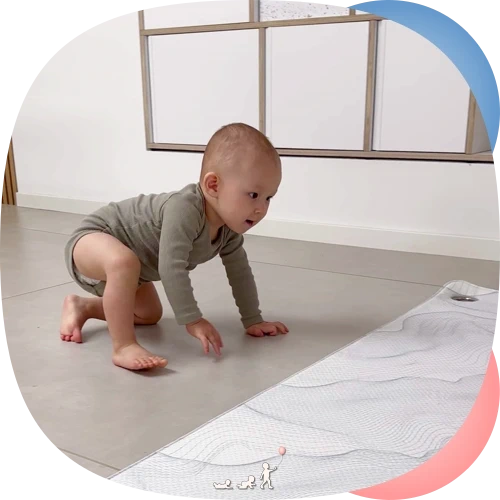
Tarzan crawling is when your baby crawls like Tarzan or Mogli from the Disney classic – on one knee and one foot instead of on both knees. Both hands are usually used, but in most cases not alternately, but simultaneously.

Tarzan crawling typically develops after a Preferred Side. If left untreated, this early stage of asymmetrical motor development will continue through all milestones. Typically, a preferred side develops into one-sided belly crawling, which then develops into Tarzan crawling.

Tarzan crawling can affect the quality of walking, because stable and solid walking requires symmetrical muscle strength on both sides of the body. Incidentally, it is always advantageous to be equally strong on both sides of the body – both for effective muscle work and for neurological development of both hemispheres of the brain.
Tarzan Crawling and Bottom Scooting FAQ What is Tarzan Crawling

What is Bottom Scooting?

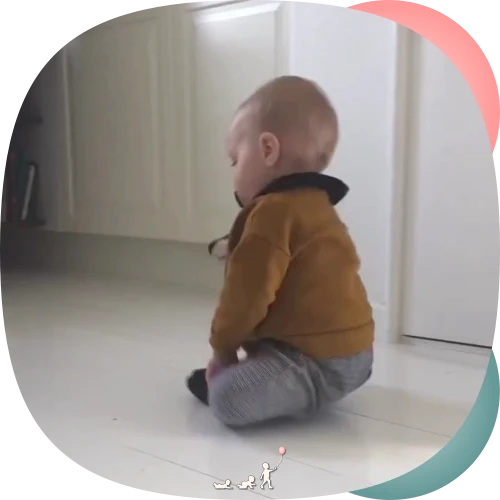
Bottom scooting means that the baby sits upright on their bottom with legs in front of the body on the floor and then pulls themselves forward by stretching and bending the legs, either straight ahead or slightly sideways. Sometimes the hands/arms are used for this type of movement, and sometimes only the legs. A common variation of bottom scooting is bottom hopping, in which the baby starts out in the same position but then supports the upper body through their arms at the ankles and then moves forward in a hopping motion (see video).

Sideways bottom scooting can develop as an alternative to Tarzan crawling after a preferred side, while babies who scoot straight ahead often have a history of over-arching their back, i.e., they have strong abdominal and back muscles, while the lateral rotation muscles are not strong enough to stabilize the body for the alternating left/right movements involved in crawling on all fours.

Bottom scooting can also cause problems in learning to walk because the baby uses both sides of the body at the same time, whereas walking requires alternating use of the left and right sides of the body. These babies compensate for the lack of stability when walking by sticking their tummies out. Although it looks cute, it is a motor compensation.
Tarzan Crawling and Bottom Scooting FAQ What is Bottom Scooting

Frequently asked questions to Tarzan Crawling and Bottom Scooting

Because I see this a lot in the clinic, I have combined these two crawling styles into one exercise program. The exercises you need to combine for your baby are clearly marked in the program.

To explain this, we need to take a step back and think about walking. For stable and solid walking, we humans need two physical coordination skills that are automatically trained through crawling on all fours, but are insufficiently or not at all trained through Tarzan Crawling or Bottom Scooting. The first requirement is symmetrical muscle strength on both sides of the body. When a baby crawls like Tarzan on one knee and one foot, the baby uses both legs and the hip and gluteal muscles asymmetrically, i.e., the two sides of the body are at different strengths as the baby attempts to transitions to walking. In bottom scooting, the baby uses both sides of the body equally well, but the baby moves both sides of the body at the same time, i.e., it does not train upper body rotation or alternating use of legs and arms, as is necessary for walking. As a result, babies who Tarzan Crawl or Bottom Scoot are often seen to have problems transitioning to walking.

Yes, this program contains tips for correcting the crawling style, but mainly exercises to help the transition to walking. It is NOT recommended to purchase the Walking program in addition to this program as both programs have the same goal, which is to learn to walk.

Tarzan crawling typically develops after a preferred side. If left untreated, the asymmetry of the preferred side can be seen all subsequent milestones. In the belly crawling stage, it is seen as one-sided belly crawling, and in the all-fours crawl stage, it is seen as Tarzan Crawling or sideways Bottom Scooting.

Babies who bottom scoot often have an undiscovered history of over-arching their back meaning they have strong abdominal and back muscles, but the lateral rotation muscles are not strong enough to stabilize the body for the alternating left/right movements of crawling on all fours.

Finally, some babies do not crawl on all fours because they do not have enough strength in their arms or because their muscles are less toned in general (soft or hypermobile babies).

No! The exercises are normal, anatomically correct strengthening exercises for the relevant muscle groups. The worst thing that can happen is that you are supporting your baby’s motor development. ๐Ÿ˜‰

I am aware that the exercises add to the stress of everyday family life. That’s why I’ve prioritized the exercises so that the five most important ones are at the top of the program and you can limit yourself to those if you’re short on time. You can do many of the exercises as part of all the little things you do in your everyday life anyway, and that’s why you can usually get your baby to walk without spending a lot of extra time on it. Of course, this is individual and depends a lot on your baby’s starting point.

Frequently asked questions to exercise programs

After completing the purchase process successfully, you can access your exercise program here on the develobaby.com. During payment, enter your email address and password. After successful payment, you will see an additional heading in the menu called “My Programs”, including links to all the exercise programs you have purchased access to. You could be reading your first program in under 60 seconds from purchasing. When you come back to DeveloBaby.com after a few days, the system will have logged you out automatically. Then simply log in again with your email address as your username and the password you chose during the checkout process.

My exercise programs are accessible online here on DeveloBaby.com. As the programs contain video clips that couldn’t be played in PDF or other types of print, there is no downloadable or hard copy version. That said, using a PC/Mac you can in fact print the exercise programs you have purchased by pressing Ctrl+P on Windows and Command+P on MacOS when you are on the exercise program page. However, the programs are not specifically set up for this purpose, so it’s much nicer and more user-friendly to view it directly on your mobile, tablet or computer.

You have perpetual access. However, I am obliged to adhere to certain privacy data regulations (such as GDPR), which state that I cannot store customer data longer than necessary. Therefore, the system limits your access to one year at a time. When a year is about to expire, the system will automatically send you an email so you can easily extend your access if you want to keep it.

No, this would be against the terms & conditions. You purchase access for yourself and the people living in your household. If you, however, buy an exercise program as a grandparent, you can of course share the access with the person you bought it for. In contrast, if you are a manager in an institution and want to procure access to one or more exercise programs for your employees, please write to me so we can work out an agreement on multiple licenses. For contact details and more, please see my Terms and Conditions.

Current legislation states that the usual 14-day right of withdrawal does not apply to digital products. The reason for this is that it is virtually impossible to argue that you haven’t used digital products once you’ve logged in. Therefore, I do not generally offer refunds. Please read more about my return policy under Terms and Conditions.

Yes, I’ve gone to great lengths to explain each exercise in layman’s terms so that everyone can follow. There are also pictures and videos to accompany the exercises, where I perform the exercises on a real baby.

No, certainly not. In my exercise programs, I have put the exercises in prioritized order. There are a lot of exercises in each program, so in principle you can spend your whole day doing exercises if you find it enjoyable, but you can also choose to do the top three or top five, and therefore the most important ones. This makes the exercise programs suitable for everyone, no matter how much time and energy you have to spare.

The exercises are basically just strength training, just like when you go to the gym. They are designed to strengthen your child muscles wrt the exercise programs’ purpose, e.g. addressing back arching. Therefore, exercises will always make your child stronger. Whether your child achieves each milestone with good quality using the exercises depends, of course, on the starting conditions and whether there are any special conditions that would require a individually tailored approach. But no matter what, helping your child build a stronger body will never be in vain. For the vast majority, standardized exercises, as presented in my exercise programs, will help the child move on to the next milestone well and strongly.

Related programs

Note: when purchasing two or more programs, a 10% discount is automatically applied. โค

  • Back Arching and Flat Head

    Exercise program for babies from four weeks of age who show signs of back arching. The program contains the same exercises as the program Tummy Time and Rolling and important additions and variations focusing on correcting the back arching, suppress skydiver position, and correct a flat back of the head.
  • Walking

    Exercise program for children who can already crawl on all fours. The program contains best-practice home exercises to support the next step toward strong and stable walking. The exercises strengthen the motor foundation by promoting the skills that are important for moving well through the motor milestones, and can be used both as cosy everyday play inspiration and in cases of motor development delay.
  • DeveloBaby Sleep

    Exercise program for babies and very young children from 4 weeks up to 2 years who find it difficult to calm down, surrender to sleep, or stay asleep due to motor restlessness or other sensory seeking behaviour. DeveloBaby Sleep also includes a wide range of concrete regulating sensory exercises as well as best-practice knowledge about baby sleep and sleep hygiene.
  • Crawling on All Fours

    Exercise program for babies who are already able to belly crawl, either with a normal cross-over pattern or by moving both arms and legs at the same time. The program contains best-practice home exercises to reliably move on to strong crawling on all fours. The exercises strengthen the skills needed to pass through the motor milestones well and can be used both as cosy everyday play inspiration and in cases of motor development delay.
  • Tummy Time

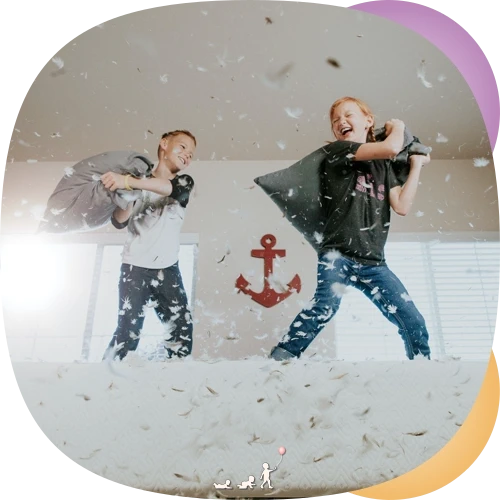
    Exercise program for babies from 4 weeks of age with simple and effective best-practice exercises for strong tummy time and rolling from back to tummy. The exercises support the gross motor foundation by strengthening the skills needed to pass through the motor milestones in the best possible way. They can be used both as cosy everyday play inspiration and in cases of mild motor delay.
  • Asymmetrical Belly Crawling

    Exercise program for children who belly crawl using only one side of the body and are not yet able to crawl forward on all fours. The program contains the same exercises as the program Crawling on All Fours and important additions and variations focusing on correcting one-sided belly crawling.
  • Preferred Side and Flat Head

    Exercise program for babies from four weeks of age who show signs of a preferred side. The program contains the same exercises as the program Tummy Time and Rolling and important additions and variations focusing on correcting a preferred side, the C-shape (banana shape), and a asymmetrical back of the head.
  • Belly Crawling

    Exercise program for babies who can already roll from back to tummy. The program contains simple and effective best-practice exercises to support the next step toward strong belly crawling. The exercises strengthen the skills that are important for reaching later motor milestones and can be used both as cosy everyday play inspiration and in cases of motor development delay.
  • Sensory Integration

    Exercise program for children from 2 years to around 12 years who show signs of sensory integration issues, whether your child finds certain types of sensory input overwhelming or has a strong need for specific kinds of sensory stimulation. Sensory Integration includes a wide range of concrete sensory-stimulating exercises as well as sensorimotor games and activities that help create better balance in everyday life.

The latest on Instagram

Follow me on Instagram @develobaby, where I share evidence based motor development knowledge and fun! โค

Disclaimer

All content on DeveloBaby.com is based on recognized professional standards in Denmark, and you can expect them to be in line with the advice you receive in the public health system. If you find that your child has pronounced sleep or motor challenges, or that there is a lack of effect from the general exercises, I recommend that you make an appointment with me, either in person or online, so that I can customize the program for your child. If your child is unwell, please always contact your health care provider or physician. Read full disclaimer…