Physical therapy for babies and children at the clinic and online
Your child is always welcome at a consultation with me, either at the clinic on Frederiksgade in Aarhus C, at Babytjekket in Frederiksberg, Copenhagen, or online.
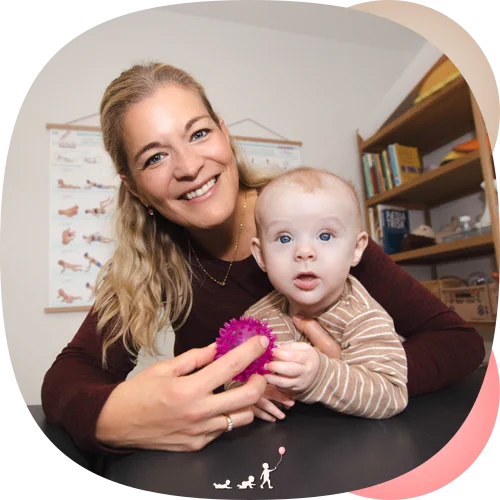
During the consultation, we first talk together, so that I get to know your child’s history well. Then I carry out relevant physical therapy examinations of your child and observe how your child moves in play. Finally, I make a plan and show you home exercises tailored to your child. If there are movement restrictions or tension, I also treat with manual physical therapy techniques as a supplement to the exercises. You are welcome to take photos or videos of the exercises I show you during the consultation.
Examples where pediatric physical therapy can be relevant
- Flat head (brachycephaly)
- Flat head on one side (plagiocephaly)
- Preferred side
- Back arching (back dominance)
- A tendency to arch backward like a bow
- C-shape / banana shape
- Difficulty lying on the tummy
- Torticollis (congenital twisted neck)
- Prematurity (born too early)
- A soft child with low muscle tone
- Delayed motor development
- Asymmetrical motor development (e.g. asymmetrical belly crawling)
- Inconsolable crying and restlessness (e.g. with colic)
- Motor restlessness
- Reduced balance
- Motor insecurity
- Hypermobility
- Growing pains
- Toe walking
- Sports injuries
- Rehabilitation after surgery or an accident
- Neck or back pain
- Signs of sensory seeking
- Signs of sensory avoiding
- Sensory processing difficulties (with ADHD, autism, anxiety)
- See also baby milestones
Injuries and pain
Before I started working full time in pediatric physical therapy, I worked for 15 years as a clinical physical therapist. During those years, I received extensive further training in sports injuries, functional analysis, dynamic stability, neck and back problems and differential diagnosis. That is why I also have a relevant educational background for helping children with injuries or pain in the body.
Referral and reimbursement
Please note that I work without a ydernummer (the agreement that lets a physical therapist treat patients with a doctor’s referral under the Danish public health service), which means that you cannot use a referral from your doctor with me. I have chosen to work without a ydernummer because specialized pediatric physical therapy takes more time than a referral allows for. So I have put time and professional quality ahead of keeping the price as low as possible. Many private health insurance plans cover the cost in full or in part, but please check with your insurer before the consultation. If you are a member of Sygeforsikringen Danmark (a Danish health insurance), you can get a reimbursement under its current rules.
Frequently asked questions about consultations
Pediatric physical therapy in Aarhus
Which service should you book?
- First consultation (55 min):
Book this service for your child if it is the first time I see your child, or if it has been more than three months since the last consultation. - Follow-up consultation (45 min):
Book this service if I have seen your child within the last three months. - Sensory integration and sleep (80 min):
Book this service if you would like an assessment and tailored advice about your child’s sensory integration and a “sensory-friendly everyday life”.
If you want to get started with relevant steps right away, you can use my online exercise programs DeveloBaby Sleep for babies from 4 weeks to 2 years and Sensory Integration for children from 2 to about 12 years.
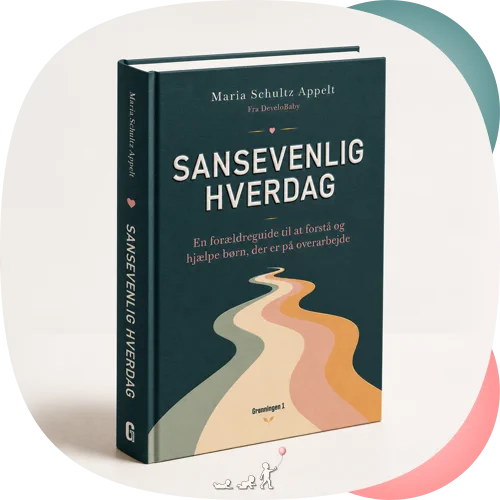
If you want more in-depth knowledge, you can read my book Sansevenlig Hverdag (in Danish), which is written for parents.
What should you write in the comment field?
When you book an appointment, it helps to write in the comment field how old your child is and to describe in a few words the main reason you booked a consultation.

Should your baby or child come along?
If you book an appointment for motor challenges, your child must always come along, so that I can see them and carry out relevant examinations. For advice on sensory integration, your child is of course always welcome, but it is up to you whether your child comes. I tailor the advice to what you tell me. I assess sensory processing difficulties based on what you tell me, not on an examination of the child, and it is often hard for a child to have to wait while the adults talk about their small and big challenges.
If you bring your child, it is a good idea to bring a little entertainment and some snacks, so your child has a good experience. At the clinic I have children’s books and coloring books. Some parents also find it helpful to bring an extra adult, for example a grandparent, who can play with the child in the playroom.
Language
Consultations can take place in Danish and in English.
Clinic address
DeveloBaby Børnefysioterapi
Frederiksgade 74E, 8000 Aarhus C, Denmark
(Apple Maps, Google Maps)
Parking
Radisson Red’s parking garage is a 2-minute walk from the clinic:
Frederiksgade 86, 8000 Aarhus C, Denmark
(Apple Maps, Google Maps)
Please note, though, that the parking spaces at Radisson Red are not very wide.
If you have a large car or need a little more room, I recommend the Musikhuset parking lot instead, a 5 to 6 minute walk away:
Margrethepladsen 2, 8000 Aarhus C, Denmark
(Apple Maps, Google Maps)
Pediatric physical therapy in Frederiksberg, Copenhagen
Note: age limit
Because space is limited at the clinic in Copenhagen, it is not possible to do a full gross motor assessment of larger children. That is why I have set an age limit of about 18 months. There may still be things I can assess in older children, though, so send me an email at maria@develobaby.com if you would like to know whether it makes sense to book an appointment.
What should you write in the comment field?
When you book an appointment, it helps to write in the comment field how old your child is and to describe in a few words the main reason you booked the consultation.

Language
Consultations can take place in Danish and in English.
Clinic address
fys:jo + Babytjekket
Prinsesse Maries Allé 17 1. tv, 1908 Frederiksberg C, Denmark
(Apple Maps, Google Maps)
Parking
Parking is available at street level. Remember to start your parking in the digital parking app. Read more about parking in Frederiksberg here.
Pediatric physical therapy as an online consultation
Note: the booking system is reserved for patients living in Denmark!
Which service should you book?
- First consultation (55 min):
Book this service for your child if it is the first time I see your child, or if it has been more than three months since the last consultation. - Follow-up consultation (45 min):
Book this service if I have seen your child within the last three months. - Sensory integration and sleep (80 min):
Book this service if you would like an assessment and tailored advice about your child’s sensory integration and a “sensory-friendly everyday life”.
If you want to get started with relevant steps right away, you can use my online exercise programs DeveloBaby Sleep for babies from 4 weeks to 2 years and Sensory Integration for children from 2 to about 12 years.
If you want more in-depth knowledge, you can read my book Sansevenlig Hverdag (in Danish), which is written for parents.
What should you write in the comment field?
When you book an appointment, it helps to write in the comment field how old your child is and to describe in a few words the main reason you booked the consultation.

Language
Consultations can take place in Danish and in English.
How does an online consultation work?
When you have booked an online consultation, I use a GDPR-compliant service called doxy.me for the online meeting itself. For security reasons, only one user can join at a time, and I cannot record the online meeting for you. So if you are two parents in different places, please make sure you record the consultation yourselves with a phone or similar.
For the best experience, I recommend that you sit somewhere with a good, stable connection, and that your phone or computer stands in a fixed place in the room rather than being held in your hand.
For online consultations, it often makes good sense for me to see a few short videos of your child before the consultation, because then we depend less on whether your child is in the mood to show the relevant things on the day. Feel free to send videos to me at maria@develobaby.com. Please keep the videos short and to the point, as that makes it easy for me to see what you want me to focus on in each video.
You are my hands in the examination. I show you on a doll what to do and guide you along the way. After the consultation, you receive the exercises as a PDF file.
Payment is made via a link I send by text message right after the consultation. When you open the link, you can pay online by card or MobilePay, just as if you were buying something in an online shop.
Courses and talks
Alongside my daily work in clinical pediatric physical therapy and as an entrepreneur, I also give many presentations, talks and courses, both for parents and for professionals.
My vision is that my talks and courses should increase the audience’s understanding and practical skills, and provide a basis for dialogue and reflection. It is important to me to turn complex theory into easy-to-use practice, so that the audience can use the new knowledge right away, whether they are private individuals or professionals.
I am happy to tailor the content to your needs, so it fits your workplace, your staff, your mothers’ group or whoever you are. The teaching can be anything from a short talk (e.g. an after-work meeting) to a course over several days, where we plan the practical details together. I give my talks in Danish and in English.
If you are interested in booking me for a talk, you will find more information and details on the Athenas website (in Danish).
Topic ideas
- A sensory-friendly everyday life (Sansevenlig Hverdag): for professionals
- A sensory-friendly everyday life in families with children
- A sensory-friendly everyday life: ADHD and/or autism
- A sensory-friendly everyday life: premature children
- A sensory-friendly everyday life and preventing poor well-being in children
- A sensory-friendly everyday life: stress management for young people
- A sensory-friendly everyday life: well-being at work
- Motor development from newborn to toddler
- Motor insecurity and DCD
Target audience
- Pediatric physical and occupational therapists
- Chiropractors
- Health visitors
- Midwives
- Baby therapists
- Doctors
- Early childhood educators
Disclaimer
All content on DeveloBaby.com is based on recognized professional standards in Denmark, so you can expect it to be in line with the advice given in the Danish public health system. If you find that your child has major difficulties with sleep or motor development, or that the general exercises are not making a difference, you may need a consultation, where the exercises are tailored to your child. If your child is unwell, you should of course always contact your healthcare provider or doctor. Read more.