Asymmetrical Belly Crawling
Exercise program for children who belly crawl using only one side of the body and are not yet able to crawl forward on all fours. The program contains the same exercises as the program Crawling on All Fours and important additions and variations focusing on correcting one-sided belly crawling.
on Trustpilot
Available languages
299,00 DKK
(inclusive of all taxes, VAT and fees)


Program description
Crawling on all fours is a key milestone because it strengthens coordination as well as the body’s strength and stability. Crawling therefore forms an important foundation for later motor skills. The vast majority of babies first move forward by belly crawling before they start crawling on all fours.
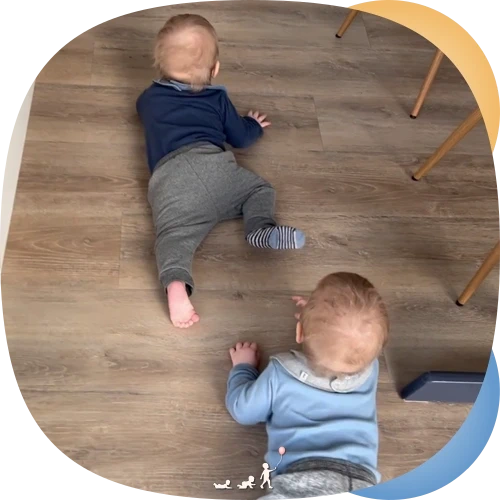
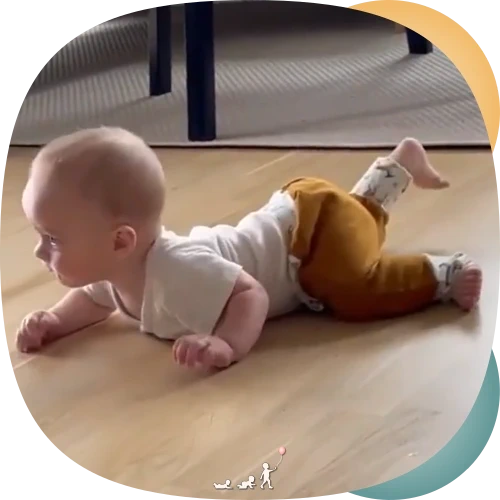
One-sided belly crawling occurs when this crawling in prone position happens mainly with only one active arm and the opposite leg. Because of the difference in strength, it becomes difficult in the hands-and-knees position to stabilize the weaker arm and leg on all fours well enough for the child to lift and move the stronger arm and leg forward. In most cases, children are still able to push up onto all fours despite the asymmetry, but then have difficulty actually moving forward.
This program contains best-practice home exercises to help your baby move on from one-sided belly crawling to stable and symmetric crawling on all fours, where the right and left sides of the body work in a cross-lateral, alternating pattern. The exercises combine a specific focus on the weaker side with strengthening of the relevant muscles around the shoulders, back, tummy, and hips, as well as targeted stimulation of coordination skills, so that the body becomes more symmetrically strong.
However, the goal of the exercises is not necessarily to achieve perfectly symmetrical belly crawling, as this is often difficult once the asymmetry has become a habit. The real long-term goal is instead strong, stable, alternating crawling on all fours.
The exercises are described in detail and arranged in a logical order. There are both pictures and videos for each exercise so you can see exactly how to do them. All texts, images, and videos are adapted to the side combination you choose, so make sure to choose the correct program version.
Note: If your baby has not yet mastered belly crawling, please choose the program: Belly Crawling.
This program is one of several in the category Crawling on all Fours – read about the differences in the program overview. Please find answers to frequently asked questions below. If you are still unsure which program is the right one for your child, you are very welcome to send an email to maria@develobaby.com.
Should you work on your child’s one-sided belly crawling, or will it sort itself out?
The answer depends on how big the difference in strength is between the right and left sides of the body, and that can be quite hard to spot if you are not used to looking for it. If the difference is something like 90% strength on one side and only 10% on the other, exercises are often necessary if the goal is for your child to start crawling on all fours. Simply because your child will find it hard to stabilize the weaker arm and leg in the crawling position once they try to move forward. If the difference is closer to, say, 60% strength on one side and 40% on the other, it is quite likely that your child will gradually sort out the belly crawling themselves and move on to crawling without much help.
Because this can be difficult to judge as a parent, my best advice is to look at whether your child previously had, or still has, signs of a preferred side. This means, for example, if your child has preferred to look to one side, has been lying in a banana shape (with the head tipped to one side), shifts their weight onto one arm in tummy time, or perhaps rolls and pivots more easily to one side. These signs tell you there may be a slightly larger strength difference between the two sides. If that is the case, it is very relevant to step in early and work preventively.
Which version of the program do I need?
It can sometimes be difficult to tell the type of asymmetry a baby has. The asymmetry always crosses over the body, which only adds to the confusion. Since it’s important that you choose the correct version, I’ve created two videos with examples to help you choose the correct version. Feel free to watch the example videos below and if in doubt, send me a short video of your child by email at maria@develobaby.com.
Right leg / left arm
- The baby crawls by pushing off the ground with their right foot and supporting their upper body mostly with the left forearm.
- The baby will have the easiest time picking up toys with the right hand in the prone position, while the left forearm supports the body weight.
- The left leg is either bent or straight, but does not contribute at all or only minimally to the crawling movement.
- Sometimes the asymmetry is most evident in either the legs or the arms. For example, when the child crawls with their right leg and both arms, or when the child crawls without using their legs, pulling forward with the left arm, you should still choose the program version “right leg“.
Left leg / right arm
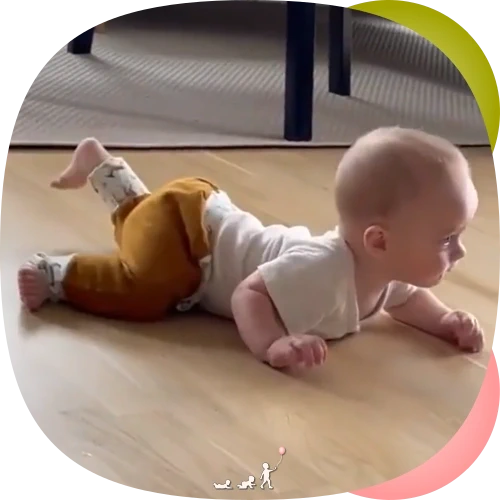
- The baby crawls by pushing off the ground with their left foot and supporting their upper body mostly with the right forearm.
- The baby will have the easiest time picking up toys with the left hand in the prone position, while the right forearm supports the body weight.
- The right leg is either bent or straight, but does not contribute at all or only minimally to the crawling movement.
- Sometimes the asymmetry is most evident in either the legs or the arms. For example, when the child crawls with their left leg and both arms, or when the child crawls without using their legs, pulling forward with the right arm, you should still choose the program version “left leg“.
Frequently asked questions to Asymmetrical Belly Crawling
Frequently asked questions to exercise programs
Related programs
Note: when purchasing two or more programs, a 10% discount is automatically applied. ❤
Preferred Side and Flat Head
Exercise program for babies from four weeks of age who show signs of a preferred side. The program contains the same exercises as the program Tummy Time and Rolling and important additions and variations focusing on correcting a preferred side, the C-shape (banana shape), and a asymmetrical back of the head.Back Arching and Flat Head
Exercise program for babies from four weeks of age who show signs of back arching. The program contains the same exercises as the program Tummy Time and Rolling and important additions and variations focusing on correcting the back arching, suppress skydiver position, and correct a flat back of the head.Walking
Exercise program for children who can already crawl on all fours. The program contains best-practice home exercises to support the next step toward strong and stable walking. The exercises strengthen the motor foundation by promoting the skills that are important for moving well through the motor milestones, and can be used both as cosy everyday play inspiration and in cases of motor development delay.
The latest on Instagram
Follow me on Instagram @develobaby, where I share evidence based motor development knowledge and fun! ❤
Disclaimer
All content on DeveloBaby.com is based on recognized professional standards in Denmark, and you can expect them to be in line with the advice you receive in the public health system. If you find that your child has pronounced sleep or motor challenges, or that there is a lack of effect from the general exercises, I recommend that you make an appointment with me, either in person or online, so that I can customize the program for your child. If your child is unwell, please always contact your health care provider or physician. Read full disclaimer…