Asymmetrical Belly Crawling

Crawling exercises with a special focus and important additions for babies with asymmetrical belly crawling, meaning they belly crawl with only one leg and the opposite arm, while the other leg barely joins in. The program contains easy best-practice exercises that strengthen the weaker side and coordination, so the body can become more symmetrically strong on the way to crawling.

  • Online-program by Maria Schultz Appelt
  • Prioritized, simple exercises
  • Designed for busy families
  • Illustrated with pictures & videos
  • Instant & perpetual access
  • Secure payment with QuickPay

Available languages

349,00 DKK

(inclusive of all taxes, VAT and fees)
Program description

In ordinary belly crawling, also called cross-pattern belly crawling, a baby moves forward on the tummy with crossing movements: the left arm pulls the baby forward while the right leg pushes, and then the right arm pulls while the left leg pushes. So the baby keeps switching between the two pairs of arm and leg. Asymmetrical belly crawling is when a baby uses only one leg: one leg pushes and the opposite arm pulls, but the baby never does it the other way around. For example, the baby pushes only with the right leg and pulls forward with the left arm (or both arms), but never uses the left leg to push.

Crawling on all fours is a key milestone, because crawling strengthens cross-coordination as well as the body’s strength and stability. Crawling therefore lays an important foundation for later motor skills. The vast majority of babies belly crawl before they start crawling on all fours. When belly crawling happens mostly with one leg and the opposite arm, it is hard to stabilize the other leg and its opposite arm to move forward on all fours. The baby can usually get up on all fours in the crawling position despite the asymmetrical belly crawling, but finds it hard to move forward.

This program contains best-practice home exercises to help your baby move on from asymmetrical belly crawling to stable crawling on all fours that alternates between the right and left sides of the body. The exercises combine a targeted focus on the weaker side with strengthening of the relevant muscles around the shoulders, back, tummy, and hips and specific work on coordination, so the body can become more symmetrically strong.

The goal of the exercises is not an even belly crawl on both sides, as that is often hard once another habit has been learned. The goal is strong, stable crawling on all fours in a symmetrically strong body.

The exercises are described in detail and listed in order of priority, with the most important at the top. Each exercise comes with both pictures and videos, so you can see clearly how to do it. All text, pictures, and videos are adapted to the side combination you choose, so make sure to choose the right program version: for the right leg or for the left leg.

Note: If your child is not belly crawling yet, choose this program instead: Belly Crawling

Note: If your baby has not yet mastered belly crawling, please choose the program: Belly Crawling.

Should you work on your child’s asymmetrical belly crawling, or will it sort itself out?

The answer depends on how big the difference in strength is between the right and left sides of the body, and that can be hard to see if you are not trained to look for it. If the strength is split 90% on one side and only 10% on the other, exercises are often necessary if the goal is for the child to crawl on all fours. That is simply because the child will find it hard to stabilize the weaker arm and the weaker leg in the crawling position as soon as they try to crawl forward. If the difference is closer to 60% strength on one side and 40% on the other, it is quite likely that the child will sort out the belly crawling on their own and move on to crawling on all fours easily.

Because this can be hard to judge on your own, my best advice is to look at whether your child has had, or still has, signs of a preferred side. That means whether your child has preferred to look to one side, has lain in a banana shape (with the head tilted to the side), puts their weight on one arm when lying on the tummy, or perhaps rolls and pivots best to one side. These signs tell you that there may be a somewhat larger strength difference between the two sides. If that is the case, it makes good sense to step in preventively.

Which side combination should you choose?

It can sometimes be hard to know which type of asymmetrical belly crawling a baby has. The asymmetry always crosses over the body, which only adds to the confusion. Because it is essential that you choose the right program, I have made two videos with examples to help you choose the right side combination. Please watch the example videos below, and if you are unsure, send me a short video of your child by email at maria@develobaby.com.

Right leg
  • The child belly crawls by pushing against the floor with the right foot and supports the upper body mostly on the left forearm.
  • The child finds it easiest to pick up toys with the right hand when lying on the tummy.
  • The left leg is either bent up or stretched out, but does not help at all, or only minimally, in the belly crawling movement.
  • Sometimes the asymmetry is most obvious in either the legs or the arms, but the program for the right leg is still the one to choose if, for example, the child belly crawls with the right leg and both arms, or belly crawls without using the legs, pulling forward with the left arm.
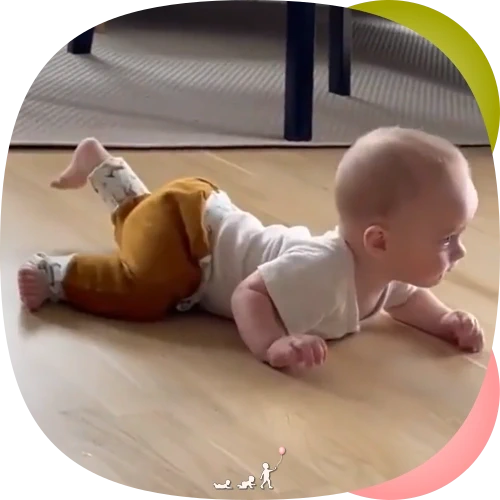
Asymmetrical Belly Crawling FAQ right
Left leg
  • The child belly crawls by pushing against the floor with the left foot and supports the upper body mostly on the right forearm.
  • The child finds it easiest to pick up toys with the left hand when lying on the tummy.
  • The right leg is either bent up or stretched out, but does not help at all, or only minimally, in the belly crawling movement.
  • Sometimes the asymmetry is most obvious in either the legs or the arms, but the program for the left leg is still the one to choose if, for example, the child belly crawls with the left leg and both arms, or belly crawls without using the legs, pulling forward with the right arm.
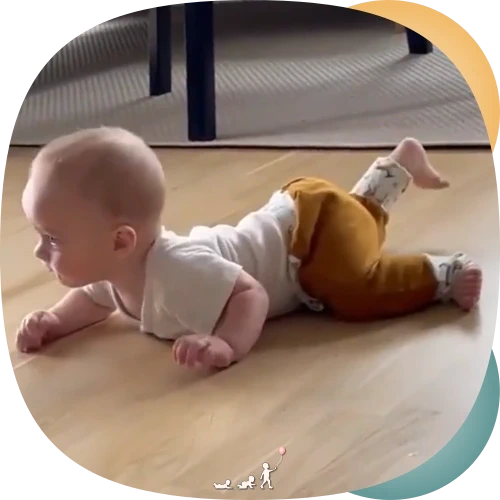
Asymmetrical Belly Crawling FAQ left

Frequently asked questions about Asymmetrical Belly Crawling

There may be small signs that are hard for a layperson to see, but if there have been no earlier signs of a preferred side, the asymmetry is probably very slight, and there is a good chance that your child will get to crawling on all fours on their own. Still, I would put the most weight on how big the asymmetry is now. If one leg is very passive in the belly crawl, or if the belly crawling phase has lasted a long time, your child may still have a marked asymmetry. You should never feel obligated to do exercises with your child if you do not have the time, the energy, or the desire. But the exercises are completely ordinary strengthening exercises, so they can be a good addition to your child’s development when you want to even out a difference between the sides and strengthen the body on the way to crawling.

Asymmetrical belly crawling develops in babies who have had a preferred side, meaning they have strengthened and used one side of the body more than the other. The muscles on the other side are therefore immature and need more training. If they do not get it, babies often switch to asymmetrical belly crawling, where they do not need to be symmetrically strong.

Asymmetrical belly crawling is usually harmless, but later it can make it hard for the baby to stabilize one arm and one leg when crawling on all fours, because the stabilizing muscles there have not had enough training.

The program is for children who move forward on the tummy with asymmetrical belly crawling, meaning mostly with one leg and the opposite arm (or both arms). If your child is not belly crawling yet, I recommend starting with the Belly Crawling program, which contains general strengthening exercises for this important prerequisite for crawling.

Both programs contain exercises for the strength and coordination that crawling requires, and both can be used once your baby can belly crawl. Choose Crawling on All Fours if your baby belly crawls using both sides of the body, either with cross-pattern belly crawling or with midline belly crawling, and Asymmetrical Belly Crawling if your baby belly crawls asymmetrically, meaning mostly with one leg and the opposite arm, while the other leg and its opposite arm barely join in.

If the asymmetry is only slight, choose Asymmetrical Belly Crawling anyway. That program includes all the crawling exercises too. Once the asymmetry is gone, you do the ordinary crawling exercises until your child is crawling.

Generally, no. The programs overlap a lot, because both support natural motor development at this stage. The Asymmetrical Belly Crawling program contains the same exercises as Crawling on All Fours, plus important additions and variations that focus on the weaker side. So as a starting point, choose only one program in the category for the same child.

Frequently asked questions about the exercise programs

You buy access to the program right here on the site. Once your payment has gone through, you’ll see an extra heading in the menu called “My Programs,” with links to all the programs you’ve bought access to. The whole thing takes less than 60 seconds.

No. You get online access to my programs here on the site, because the programs contain video clips, which of course can’t be played on paper or in a PDF. That’s also why there is no version you can download or have sent to you. You can actually print the programs you’ve bought from a computer, though, by pressing Ctrl+P on Windows or Command+P on macOS while you’re on the program page. The programs aren’t set up for printing, however, so they look much nicer and are easier to use directly on your phone, tablet or computer.

You have lifetime access. Once you’ve bought a program, you can always log in and use it again whenever you need it, without having to renew or pay for access.

No, that isn’t allowed. You buy access for yourself and the people who live in your household. If you buy as a grandparent, for example, you may of course share it with the person you bought it for. If you are the director of a daycare center, for example, and would like to buy one or more programs for your staff, just email me at maria@develobaby.com so we can work out an arrangement for multiple licenses. Read more in my Terms and Conditions.

As a rule, no. The exercise programs are digital products that you get access to right away, so the usual 14-day right of withdrawal doesn’t apply to them. If you bought the wrong program by mistake, or something else doesn’t fit your situation, just write to me at maria@develobaby.com. Then of course we’ll find a solution together. You can read more in my Terms and Conditions.

Unfortunately, I see this from time to time: the card issuer, that is, your bank, blocks the payment because it goes to Denmark, especially if you don’t usually shop in other countries or only do so rarely. In that case, there’s not much I can do. You can call your bank and ask them to authorize the payment manually. Or you can try one of the other payment methods at checkout, for example Apple Pay or Google Pay.

Yes, I’ve taken great care to explain every exercise in plain language so everyone can understand it. The exercises also come with pictures and videos where you can see them done with a real child.

As a rule, no. The exercises in my motor programs are ordinary strengthening exercises in the anatomically normal muscle pattern, and the exercises in my sleep and sensory programs are calm exercises that stimulate the senses. If your child gets tired or upset, take a break, and if you are unsure about your child’s health, talk to your healthcare provider or doctor.

No! In my exercise programs, I’ve put the exercises in order of priority. There are lots of exercises in each program, so in principle you could spend the whole day doing exercises if you enjoy it, but you can also choose to do, say, the top three or five, which are the most important ones, if you’re short on time. That way, the exercise programs are for everyone, no matter how much time and energy you have.

The exercises in my motor development programs are basically strength training, just like when you do exercises yourself to get stronger. They are designed so the child strengthens the muscles that matter at exactly the stage you bought the exercises for. That’s why they help make the child stronger on the way to the next milestone. Whether the child gets good-quality movement patterns at the next milestone with the exercises in the program naturally depends on how strong the muscles are to begin with, and on whether there are special circumstances that call for a more individually tailored approach. These could be, for example, congenital disabilities or neurological injuries. But helping your child toward a stronger body is never wasted effort.

Related programs

Note: when purchasing two or more programs, a 10% discount is automatically applied. ❤

  • Crawling on All Fours

    Exercises for crawling on all fours for babies who belly crawl, either with ordinary cross-pattern belly crawling or with midline belly crawling. The program contains easy best-practice exercises that strengthen both sides of the body equally and support your baby on the way from belly crawling to crawling. The exercises can be used both as playful everyday inspiration and in cases of motor delay.
  • Back Arching and Flat Head

    Tummy time and rolling exercises for babies from 4 weeks, with a special focus and important additions for back arching, a flat head and the skydiver position. The program contains simple best-practice exercises that strengthen the muscles your baby needs to lie comfortably on their tummy and to roll.
  • DeveloBaby Sleep

    Exercises for babies and very young children from 4 weeks up to 2 years with motor restlessness or other sensory-seeking behavior that makes it hard to settle, give in to sleep, or stay asleep. You get a wide range of practical, regulating sensory exercises that are easy to fit into a busy daily routine, plus best-practice knowledge about baby sleep.
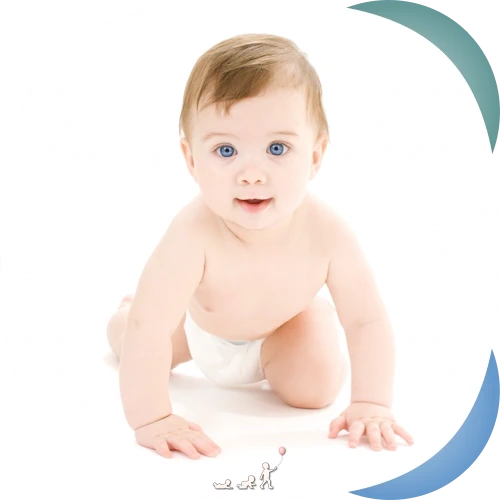
  • Walking

    Walking exercises for children who crawl on all fours, including children who already walk with support but don’t walk on their own yet. The program contains easy best-practice exercises that strengthen the body for strong, steady walking, and my best tips on how your child can find the courage to take those first steps without holding on. The exercises can be used both as playful everyday inspiration and in cases of motor delay.
  • Tarzan Crawling and Bottom Scooting

    Walking exercises with a special focus and substantial additions for children who crawl with one foot planted on the floor (Tarzan crawling) or get around sitting on their bottom (bottom scooting), and who don’t walk without support yet. The program contains easy best-practice exercises that strengthen both sides of the body and the rotation muscles, so the body can become more symmetrically strong on the way to steady walking.
  • Belly Crawling

    Exercises for belly crawling in babies who can roll from back to tummy but don’t yet move forward on their tummy. The program contains simple best-practice exercises that support your baby on the way to strong belly crawling using both sides of the body. The exercises strengthen the motor foundation for the next milestones and can be used both as playful everyday inspiration and in cases of motor delay.
  • Sensory Integration

    Sensory integration exercises for kids from 2 years to around 12 years who are sensory seeking and need a lot of sensory stimulation, or who are sensory avoiding and easily overwhelmed by loud noises, touch, or clothing. The program contains a wide range of practical sensory-stimulating exercises, plus sensorimotor games and activities that are easy to do at home.
  • Preferred Side and Flat Head

    Tummy time and rolling exercises for babies from 4 weeks, with a special focus and important additions for a preferred side, a flat head on one side and a banana shape. The program contains simple best-practice exercises that strengthen the muscles your baby needs to lie comfortably on their tummy and to roll.
  • Tummy Time

    Tummy time and rolling exercises for babies from 4 weeks, as playful everyday inspiration and in cases of mild motor delay. The program contains simple best-practice exercises that strengthen the muscles your baby needs to lie comfortably on their tummy and to roll.

The latest from Instagram

Follow me on Instagram @develobaby, where I share evidence based motor development knowledge and fun! ❤️
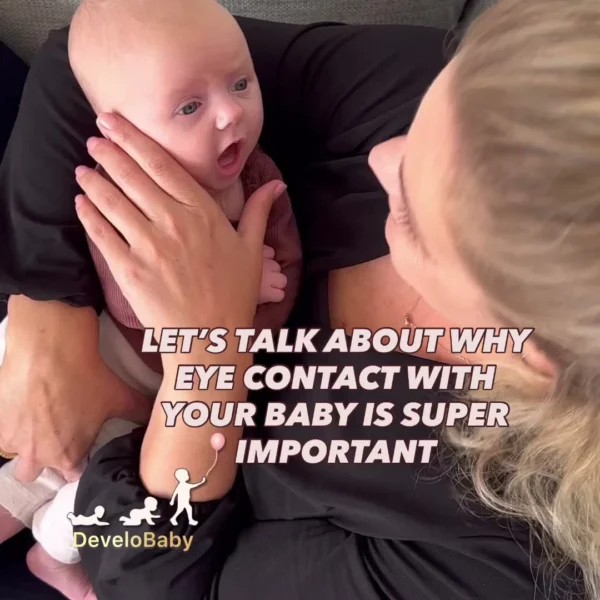
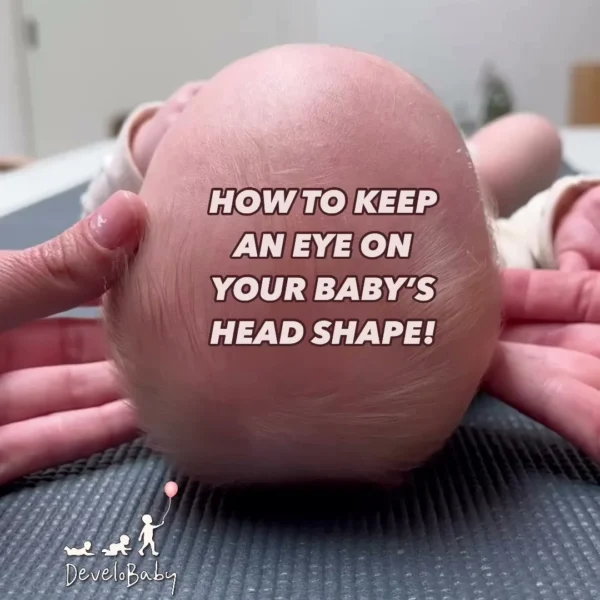
Eye contact is important for brain development. When your baby gets enough eye contact, the ability to communicate and …It can save you months of training and attention if you monitor your baby’s head shape from the start. This way, you ca…Baby sleep can feel like a puzzle with way too many pieces. The reason a baby doesn’t sleep well is often hard to pinpo…